MPTS streams
MPTS (Multi Program Transport Stream) is an MPEG-TS stream carrying several programs (services); every program has a unique number (PNR). Its main applications are DVB broadcasting and the pass-through of ready-made multiplexes. The stream type — SPTS or MPTS — is selected at creation time and cannot be changed later (New stream).
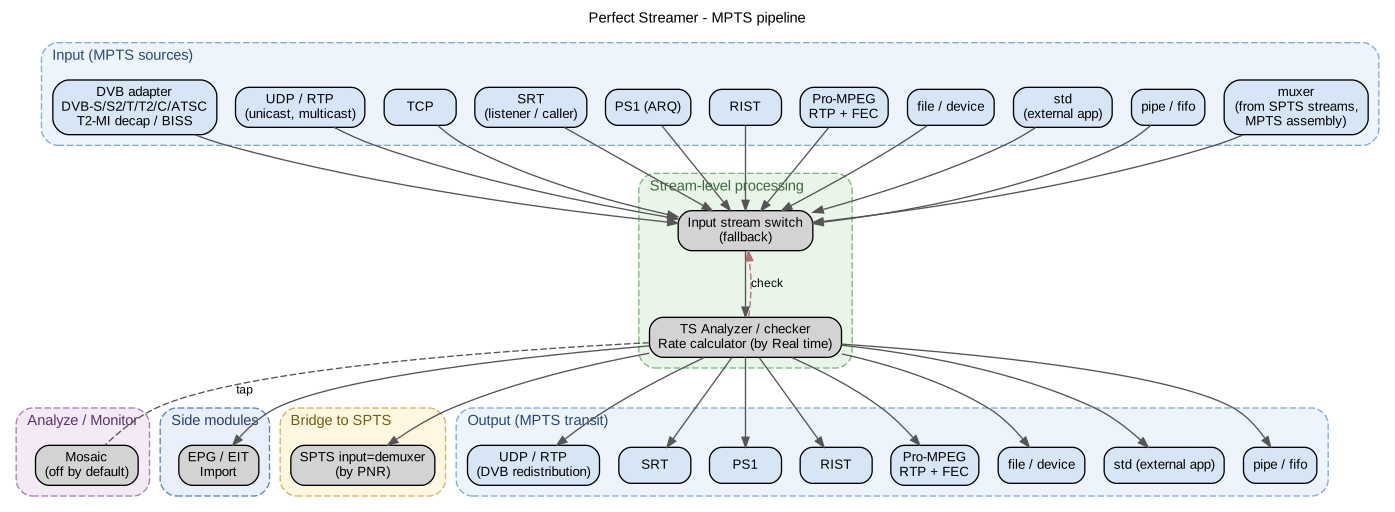
MPTS stream pipeline: pass-through of the multiplex without any change to its composition; individual programs are processed through the demultiplexer in SPTS streams.
Multiplex pass-through
An MPTS stream is a pass-through stream: the multiplex is transmitted as is. MPEG-TS filtering and modification (MPEG-TS filtering, Stream modification), the bitrate modes (Bitrate control), OTT delivery and DVR recording (OTT and DVR) do not apply to an MPTS stream. The constant bitrate and the composition of an own multiplex are set when it is assembled by the multiplexer (Multiplexer); an individual program is processed after it has been extracted into an SPTS stream (Demultiplexer).
The sources of an MPTS stream are the network transports that receive a ready-made multiplex (UDP / RTP, SRT, PS1, RIST, Pro-MPEG, TCP, file and others — see Planning and data transmission protocols), the DVB receiver (DVB receiver) and the multiplexer (Multiplexer). Single-program sources — HLS, RTSP, RTMP, the demultiplexer, the transcoder, the test generator — are not available for MPTS. The outputs are transport outputs, including delivery of the multiplex into a DVB distribution network; an MPTS stream has no OTT outputs.
Source redundancy works in the same way as for SPTS streams: several inputs ordered by priority, the stream timeout, the check interval and the return to the primary input (Source redundancy).
Per-program analysis
The analyzer of an MPTS stream keeps its accounting per program separately and in summary for the whole multiplex: bitrate, state and continuity errors, scrambling, media information for every program, and the identifiers of the multiplex (TS ID and network identifier). The summary program counters — total, clean, scrambled and with faults — are shown in the stream statistics window (Stream statistics); in the stream list, MPTS streams are marked with the MPTS badge and placed in a separate group. A scrambled program is considered valid and is not added to the error counter.
For MPTS, the TR 101 290 monitor (the “Analyze” tab, the “TR 101 290 monitor” setting) issues a single verdict for the whole multiplex: transport errors, continuity across all PIDs, PCR repetition and PCR discontinuities across all programs, the presence of the PAT/PMT and SI tables (NIT, SDT, EIT, TDT). The window of the permissible PCR jump is set by the “PCR discontinuity window (ms)” input setting — as for SPTS streams (Synchronization). The in-depth SPTS metrics — PCR accuracy, T-STD video buffer analysis, PTS intervals — do not apply to the multiplex as a whole: for a detailed analysis of a program, extract it into a separate SPTS stream (Demultiplexer, Analyzer).
For an MPTS stream the mosaic is disabled by default (the “Generate mosaic” setting); when it is enabled, a thumbnail is produced for every program of the multiplex. This is a noticeable additional load — enabling the mosaic of a multiplex on loaded servers is not recommended.
BISS descrambling
The network and file inputs of an MPTS stream (UDP / RTP, SRT, RIST, Pro-MPEG, TCP, PS1, file and similar) support software BISS descrambling per program: “program number — key” pairs are specified (BISS-1 or BISS-E), and every listed program is decrypted before analysis and further transmission. Descrambling at DVB adapter level — CAM and BISS, including the keys for T2-MI — is described in DVB receiver.
Multiplex EPG
The programme guide carried in the multiplex is extracted into the node’s EPG database by the “Extract EIT to EPG database” setting (EPG/XMLTV import). EIT generation is not performed on a pass-through MPTS stream: the EIT tables of the programs are carried over by the multiplexer from the source streams during assembly (Multiplexer, EIT generator).
