Purpose
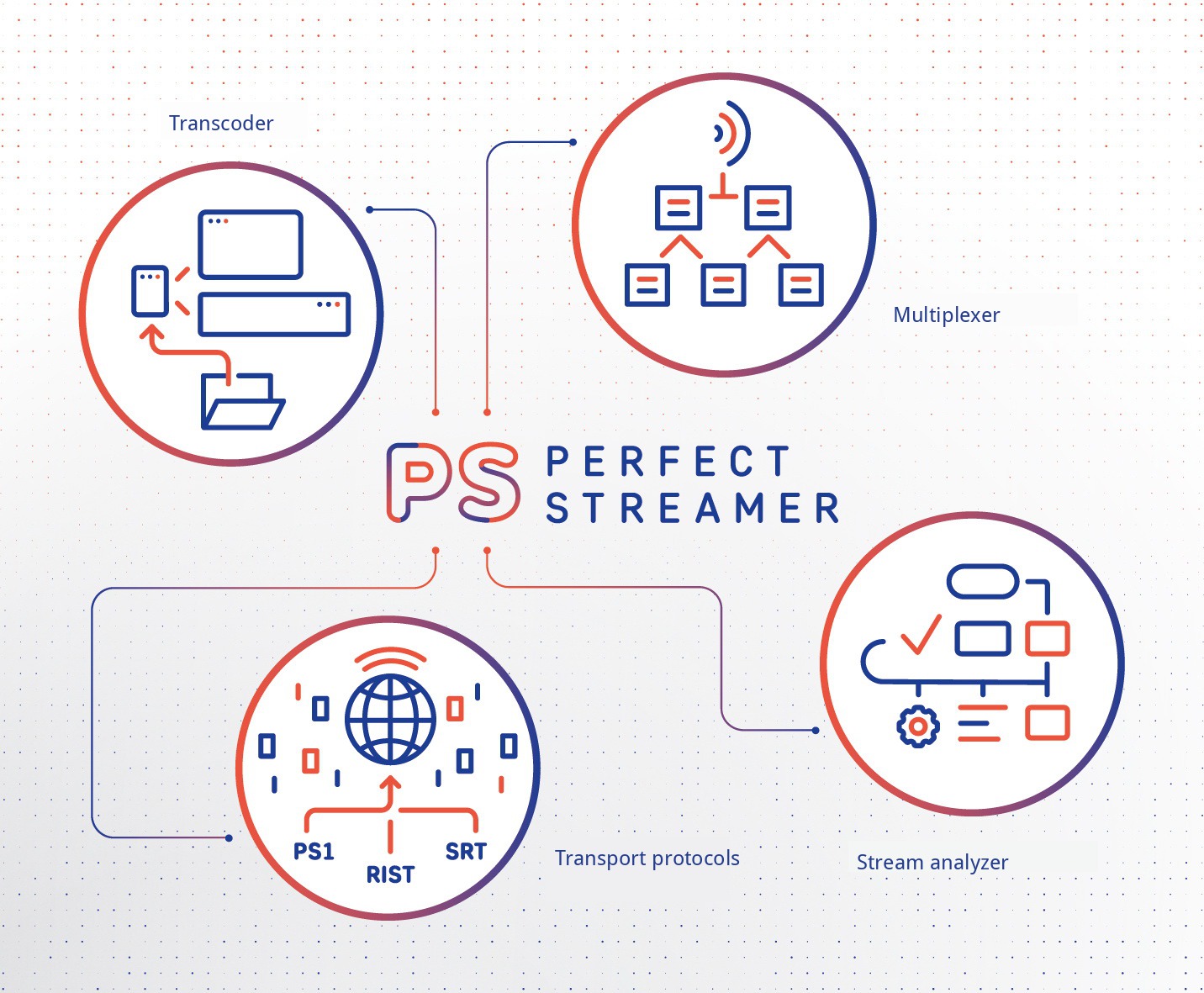
Perfect Streamer is server software for the reliable delivery of MPEG-TS streams across the public Internet with packet loss and latency. It also receives, processes, multiplexes and transcodes television channels and delivers them over OTT. The product is designed for broadcasters and telecom operators: backbone channel transport between operators, DVB-to-IP headends, IPTV/OTT platforms, and distribution networks.
Perfect Streamer is shipped as a single application for Linux x86-64 with a built-in web interface and HTTP API. A single installation performs all stages of the pipeline: reception, processing and remultiplexing, transcoding, transport between nodes, OTT distribution and the archive (DVR), monitoring.
Stream transport between nodes
For each stream, a transmitter server (Sender) and one or more receivers (Receiver) are configured. Four Peer protocols are available for transporting streams between the transmitter and the receiver, as well as for communicating with third-party equipment:
PS1 (Perfect Stream) — a proprietary UDP-based protocol that operates on the Automatic Repeat reQuest (ARQ) principle with selective retransmission. It needs few resources and carries high-bitrate streams, including a full-size MPTS. It is best suited to point-to-multipoint configurations: one sender and many receivers.
SRT — an open protocol that is widely adopted and compensates well for packet loss; listener/caller modes; compatible with third-party equipment and cloud services.
RIST — an open protocol based on RTP/RTCP. It operates on the ARQ principle without ACK, using only NACK; Simple and Main profiles.
Pro-MPEG COP3/RTP+FEC (SMPTE 2022-1/2) — RTP with forward error correction (FEC) and no return channel. Its advantages are low latency and compatibility with professional broadcast equipment. Its drawbacks are constant additional traffic and poor recovery under large packet loss.
AES encryption is supported by PS1, SRT and RIST in the Main profile; in Pro-MPEG it is implemented as a non-standard extension (Stream encryption). A detailed description of the protocols and transport channel planning are in the Planning and data transmission protocols section.
In addition to the Peer protocols, standard inputs and outputs are supported: UDP (unicast/multicast), RTP, HLS/HTTP, RTMP/RTMPS, file/device, named pipe (pipe) and external application (std). TCP and RTSP are supported as inputs only.
Main functions
Processing without transcoding — allowed and blocked PID lists, PID remapping and automatic PID arrangement for the programme, editing of the SDT and audio languages, PNR change, removal of unneeded tables (SDT/CAT/NIT/TDT, teletext, subtitles), bringing PAT/PMT intervals into compliance with TR 101 290; bitrate modes, including CBR with stuffing up to a DVB-compliant constant bitrate.
MPTS multiplexer — assembling a multiplex from individual programmes with PSI/SI generation and an output compliant with TR 101 290.
Demultiplexer — extraction of individual programmes from an MPTS into standalone SPTS.
Transcoder — hardware transcoding on NVIDIA GPU and Intel VPL, software transcoding on the CPU; multiple encoders from a single decoder (for example, for adaptive bitrate).
Analyser — TR 101 290 (DVB) compliance monitoring for SPTS and MPTS, PCR drift detector, T-STD buffer model, deep stream analysis, SCTE-35 analyser, CBR/VBR detector.
EPG and EIT — capturing EIT from the air into the EPG database, XMLTV import, generating correct EIT (present/following and schedule) into the outgoing stream, forced SDT generation.
EPG server — serving full XMLTV at
/xmltvwith the channel set restricted by login, for OTT middleware.Test streams — a built-in test signal generator.
Meshwork — combining servers into domains based on the gossip protocol of decentralised networks. A domain has live node status, a shared catalogue of the addresses and ports in use (the resource library) and alert replication.
Session accounting and access control — connection limits per user, per-channel ACL, prefix/suffix login for integration with middleware. Authorisation of client sessions in external billing — verification of each session on connection and periodic reauthorisation with access revocation in the middle of a session (a RADIUS-style lifecycle: Start / Interim / Stop); a universal HTTP connector for connecting the operator’s billing. Accounting is done separately for each protocol — HLS/DASH for OTT and PS1/SRT for stream peering.
Web interface — management of all functions, administrator roles, adaptive profiles for workstation, tablet, and phone.
Automatic TLS certificates (ACME) — automatic issuance and renewal of certificates, hot reload of TLS; HTTPS and HTTP/3 out of the box.
Analyser and monitoring — TR 101 290 (DVB) monitoring at the input, unified alerting delivered via Email, Telegram, or to an external script, channel mosaic.
Also available: source redundancy with automatic failover; integration with monitoring systems (Zabbix, Grafana, Prometheus, InfluxDB, Nagios); integration with external billing to authorise client sessions; backup and export/import of settings.
For DVB broadcasters
Available to satellite, cable, and terrestrial broadcasting headends (DVB-to-IP, remultiplexing, inter-site contribution):
Reception from DVB cards — DVB-S, DVB-S2, DVB-T, DVB-T2, and DVB-C with a full set of tuning parameters; LNB and DiSEqC 1.0 control, LNB sharing between tuners.
Transponder scanner and blind scan — traversal of the reference lists (satellites.xml, cables.xml, terrestrial.xml) with PSI/SI collection, building a multiplex → programme tree, and measurement of SNR, level, and BER; discovery of non-standard transponders without a reference file.
Descrambling — hardware CI/CAM (EN 50221) with a CAM combined with the DVB receiver, and software BISS-1 / BISS-E (keys by PNR or PLP, hot update). Conditional-access cleanup on output — removal of ECM/EMM, CAT, and CA descriptors from the PMT to obtain a clean FTA stream.
T2-MI decapsulation (ETSI TS 102 773) — simultaneous output of the outer DVB-S/S2 multiplex and all embedded T2-MI carriers. This way regional DVB-T2 is received over satellite without a separate gateway.
Signal monitor (femon) — continuous measurement of lock, level, SNR, BER, and UCB with plotting over time.
Demultiplexer — extraction of an individual programme (by PNR) from a received transponder into a standalone SPTS.
For OTT broadcasters
Available to IPTV/OTT operators and distribution platforms:
OTT delivery — HLS, Low-Latency HLS, and MPEG-DASH over CMAF; delivery over HTTPS and HTTP/3 (QUIC); adaptive multi-bitrate (ABR) in a single master playlist; GOP/IDR-aligned segmentation; raw MPEG-TS over HTTP for TS clients.
WebVTT subtitles — decoding of DVB teletext and DVB subtitles into WebVTT for OTT players, including in the archive.
Network DVR — recording of each OTT channel to a disk archive in parallel with delivery; archive playback via the same HLS/DASH URLs (timeshift and VOD), archive → live transition without redirects or re-authorisation, EPG-based catch-up, adaptive VOD and CMAF archive, multi-disk storage with retention and automatic cleanup.
Transcoder and ABR ladder — multiple encoders, each with its own resolution, bitrate, and codec, work from a single decoder (1toN); in hardware on the GPU (NVIDIA, Intel VPL) or in software on the CPU.
CDN readiness — content-addressable segments with immutable headers, a normalised cache-key, and CORS for scaling behind a reverse proxy or CDN.
